
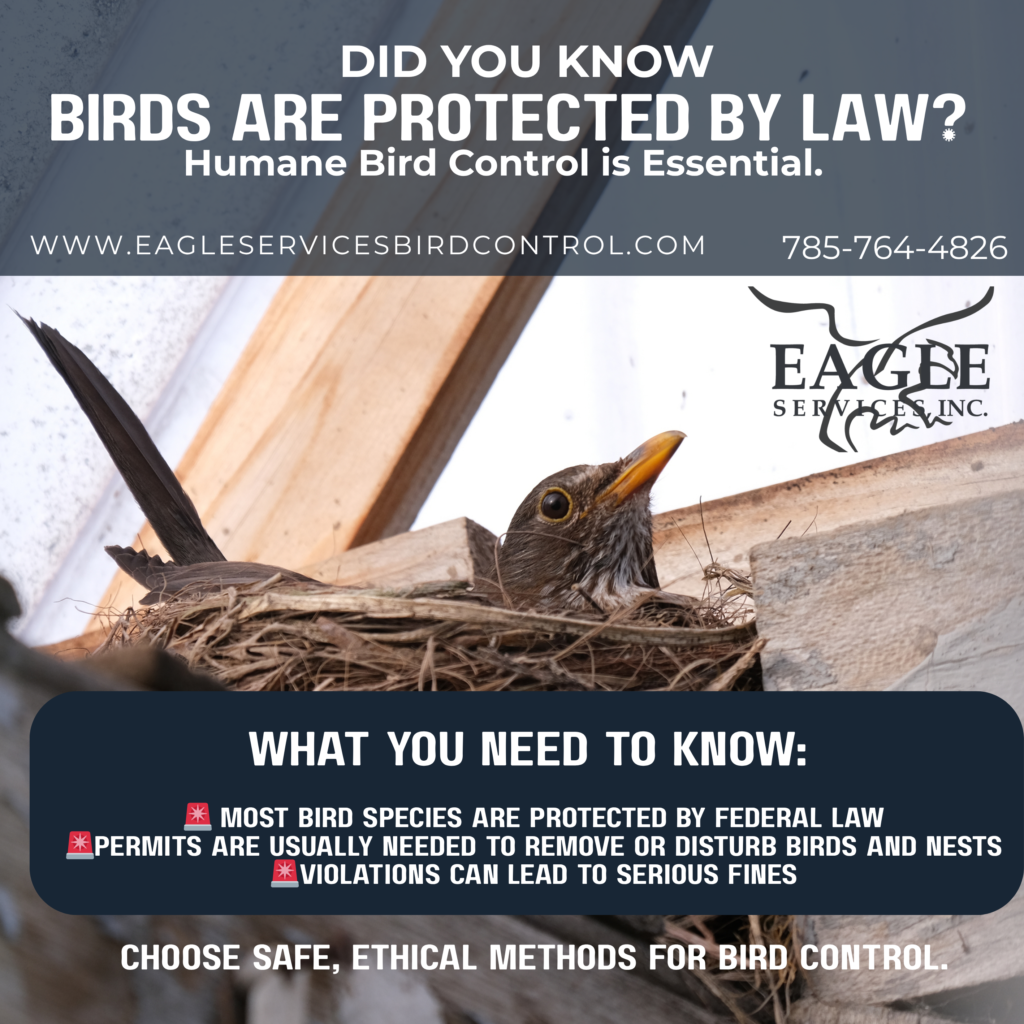
It’s one of the most common questions we hear – and the answer is yes, most birds are protected by law.
Understanding how those protections work is an important part of addressing bird issues the right way — especially for commercial properties.
Federal Protection: What You Should Know
In the United States, many bird species are protected under the Migratory Bird Treaty Act.
This federal law makes it unlawful to:
- Harm or kill protected bird species
- Disturb or remove active nests (especially those with eggs or chicks)
- Possess or relocate birds without proper authorization
These protections apply to a wide range of common birds found around commercial buildings, including pigeons, sparrows (in some cases), and other migratory species.
What this means for businesses is simple:
once birds begin nesting, your options can become limited very quickly.
State-Level Regulations Also Apply
In addition to federal protections, many states have their own wildlife regulations that further guide how bird control must be handled.
For example:
In Kansas, wildlife laws support federal protections and regulate how birds can be managed, especially when it comes to nesting activity and humane treatment.
In Missouri, similar regulations are in place, reinforcing the importance of handling bird issues in a way that aligns with both state and federal guidelines.
While specific rules can vary slightly by location and species, the overall approach is consistent:
Bird control must be done responsibly, legally, and humanely.
Why This Matters for Commercial Properties
When bird activity is ignored early on, it can lead to:
- Active nesting in hard-to-reach areas
- Delays in addressing the problem
- Increased costs due to limited options
- Compliance concerns if handled incorrectly
Once nests are active, especially during nesting season, removal or disturbance may not be allowed until the birds have naturally left.
The Role of Professional Bird Control
Professional bird control focuses on:
✔️ Prevention before nesting begins
✔️ Humane exclusion methods
✔️ Compliance with all applicable regulations
✔️ Long-term solutions tailored to the structure
The goal isn’t to harm birds – it’s to prevent them from settling in places where they create risk for people, property, and operations.
The Bottom Line
Yes, birds are protected and for good reason.
But that doesn’t mean businesses have to live with the damage, safety concerns, or disruptions that can come with unmanaged bird activity.
With the right approach, it’s possible to protect both your facility and the wildlife around it.
If bird activity is starting to increase around your property, addressing it early – before nesting begins – is always the most effective path forward.
